


Microchipping is a permanent identification method for cats and dogs. Unlike a collar, a microchip can’t be taken off or lost. It remains with your pet for life.
If your cat is lost, a microchip can help you find it again. According to the American Veterinary Medical Association (AVMA), 38.5 percent of microchipped cats are reunited with their owners, compared to only 1.8 percent of those without a chip.
What Is a Microchip?
A microchip is a tiny electronic device that’s implanted under a cat’s skin between its shoulder blades.
If your cat becomes lost and is taken to a shelter or veterinarian, the staff will scan the cat to see if it has a microchip. The scanner has radio waves that activate the chip. When this happens, the chip sends its unique ID number back to the scanner.
A staff member will enter this ID number into a registry, which is a database, and receive your contact information. Then they’ll call you to let you know they have your cat.
Organizations such as Alley Cat Allies support microchipping. It reduces the chance that a lost cat will be euthanized if it is taken to a shelter.
Better Than a Collar
You might be thinking, “My cat wears a collar with an ID tag, so it doesn’t need a microchip.” Yes, it does, because a collar can slip off a cat. A microchip, on the other hand, cannot.
We used to put breakaway collars with ID tags on our cats. A breakaway collar is designed to be safe. It unhooks if a cat gets caught on something. This keeps the cat from strangling or becoming trapped.
But a breakaway collar can fall off. If your cat escapes your home and winds up outside, it’s going to panic. It might hide under a porch or a shed. If its collar becomes snagged on something, like a branch, the clasp will unhook. Then your cat doesn’t have identification information.
A microchip is a better option.
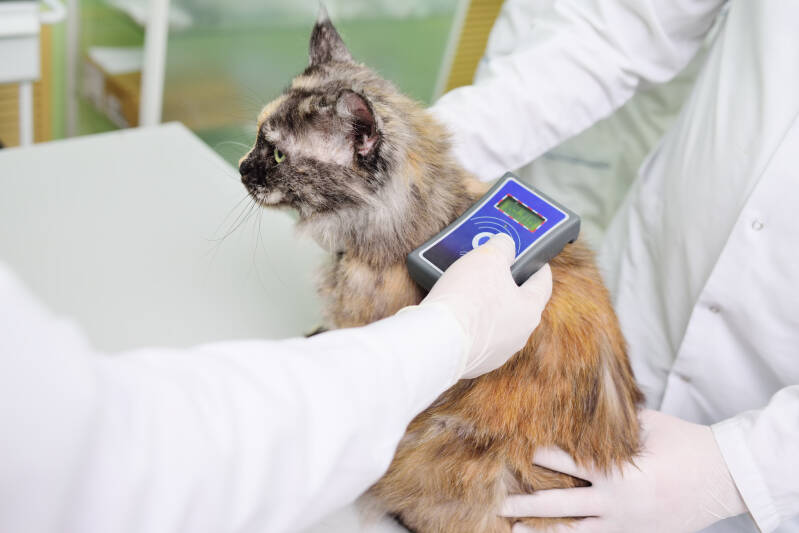
A cat being scanned for a microchip
Does a Microchip Hurt?
Microchipping is a quick and nearly painless process. It’s similar to a human ear piercing—a prick and then some mild soreness. After this, it’s painless.
Cats don’t need to be under anesthesia to get a microchip. However, people often get their cats microchipped when they are under anesthesia to be spayed or neutered.
Follow These Three Steps to Microchip Your Cat
- Get your cat microchipped. Your veterinarian can do this, or you can take your cat to a low-cost clinic.
- Register the microchip with a registry, or database. Some charge a fee but others are free.
- Update your contact information with the service if you move or change your phone number.
Where to Get Your Cat Microchipped
Your veterinarian can microchip your cat for about $50. However, the cost may be higher if the office registers the chip in a registry for you.
Our veterinarian charges about $100 to microchip a cat. The vet’s office uses a microchip made by HomeAgain Pet Recovery and registers it with this service (https://www.homeagain.com/). The staff also takes care of renewing the subscription.
Ask your vet if they register microchips. Some do this free of charge. If not, you need to register the microchip with a registry yourself. PetLink is a common registry. It charges a one-time fee of about $30 to register a microchip (https://petkey.org/).
Low-cost clinics can also microchip your cat. Tractor Supply’s PetVet offers low-cost microchipping and vaccinations (https://petvet.vippetcare.com/services-pricing/). A microchip costs about $25, depending on your location. This includes the microchip’s registration.
Some free microchip registration services require the microchip to be a certain brand. For example, SmartTag offers free microchip registration for its own tags (https://idtag.com/register/).
911PetChip is a free registration service (https://www.freepetchipregistry.com/). You can use this service to register a microchip of any name brand.
After your microchip is registered, check to see if you need to renew your subscription every year or every few years.
Update Your Contact Information
Your cat’s microchip is useless if the information in the registry isn’t current. Contact the registry if you change your name, address, or phone number.
Success Stories
Microchipped cats have been returned months or years after becoming lost. A microchip allows cats that wind up far from home to be reunited with their owners.
Baby
Alfonso and Sherrie Meletiche from Fort Myers, Florida, lost their beloved cat, Baby, a brown-and-white Maine Coon mix. They had taken Baby with them while making a long-distance truck delivery to Southern California.
Sherrie was walking Baby outside on her harness when Baby heard a loud noise and broke free. A search team was unable to find Baby.
Ten months later, Alfonso received a call from a woman who had found a cat and had it scanned for a microchip. The woman told him the cat was Baby. However, before Alfonso could fly to California to get Baby, she escaped again.
Baby was captured a second time by a woman who had been staying at a resort, where guests had been feeding Baby. This time, the little cat didn’t get away.
Alfonso flew from Florida to Southern California to pick her up. On the way back to Florida, Baby was allowed to fly in the plane’s cabin with the other passengers, as long as she stayed in her cat carrier.
Alexander
Alexander, an orange-and-white cat, had a loving home in Mount Laurel Township in New Jersey until he slipped out of a screen door and disappeared.
His family searched for him routinely but never found him. They responded every time someone found a cat matching Alexander’s description, but it was never him.
Two years later, someone found an orange-and-white male cat and dropped him off at the Burlington County Animal Shelter in New Jersey. The cat was terrified at first and wouldn’t let anyone touch him.
However, after a few days, he began to relax and enjoy the attention he was receiving. It was then that his caretakers scanned him for a microchip. It connected him back to his family, who were tearfully reunited with their beloved feline.
Sources:
Turner, Andrew. “Reunited and it feels so good: Microchip returns cat to family after 10 months apart.” Daily Pilot, 1 July 2023, https://www.latimes.com/socal/daily-pilot/news/story/2023-07-01/reunited-and-it-feels-so-good-microchip-returns-cat-to-family-after-10-months-apart.
White, Nicolette. “Missing Mount Laurel Cat Returns to Family After Two Years.” Burlington County Times, 26 Mar. 2021, https://www.burlingtoncountytimes.com/story/news/2021/03/26/missing-mount-laurel-cat-found-after-two-years/7011043002/.