

Losing a cat is a stressful, heartbreaking experience. Indoor-only cats occasionally escape—even the most attentive cat owners can lose their cats. A child may leave a door ajar, or a window screen may fall out.
While it’s important to act quickly, be aware that a scared cat will hide and may not come out of hiding until it’s very hungry. Cats can last for days without food if they have access to water.
Step 1: Make sure your cat isn’t hiding inside your home.
If your cat was exposed to loud noises, such as construction in your home or fireworks, it may be hiding in your house. Cats have been known to crawl inside mattresses and furniture.
My friend’s cat hid in a wall. Yes, you read that right. He went inside a kitchen cabinet, found a hole in a wall, crawled into it, and stayed there for days. A cat rescue group used a thermal imaging camera to find him.
Thermal imaging cameras are awesome, by the way. They detect the heat given off by an animal’s body. The camera displays the heat as a bright spot against a dark background. Firefighters use thermal imaging cameras after a fire to find pets trapped under floorboards.
You may be able to borrow this type of camera from your local fire or police station or a cat rescue group.

Step 2: Search outside your home.
Most indoor cats that get outside stay very close to home. They might hide under a porch or some bushes. Unless your cat is very outgoing and social, it’s not going to come when you call it. It’s going to stay put, at least for a while.
I once found one of our cats wedged between a tree trunk and a wooden fence. I was standing right next to her and calling her, but she didn’t move. I had to pull her out of her hiding place to take her back inside.
Step 3: Make flyers and posters.
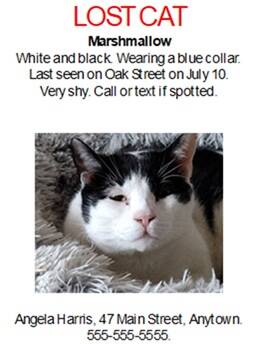
Flyers showing a picture and a description of your cat, along with your contact information, can be very helpful. Pass your flyers out to your neighbors. Turn flyers into posters by putting them inside plastic sheet protectors. Staple posters onto nearby telephone poles. (You need a staple gun to do this.)
Ask for permission to post flyers in local grocery and convenience stores. If you give a flyer to a local veterinary hospital, the staff will usually hang it in a window or post it on a bulletin board. Remember to take the posters down or call veterinary hospitals when you find your cat.
Step 4: Sit outside at dawn and dusk.
Cats typically come out at these times. Sit quietly and call your cat. Place strong-smelling wet cat food or sardines close to you. If your cat responds to the crinkling sound of a treat bag, bring one of these.
Step 5: Consider leaving a door or window open.
Many lost cats will try to get back into the house late at night. If you have other cats or dogs, put them in a room and close the door. Leave a door or a window open—all night if you can. One of our cats slipped out of the house when our kids left the front door open. He came back through an open door around two in the morning. I stayed on a sofa near the door until he was home.
Step 6: Use home security cameras.
If you put food out on your porch or near your front or back door at night, you might catch a glimpse of your cat on a home security camera, also called a motion-detection camera. These cameras turn on if a person or an animal moves in front of them. They send videos to your phone.
You can also use a trail camera (or trail cam) to help you find your cat. A trail cam is powered by batteries and can be mounted to a tree or a fence. Like a home security camera, it has a motion detector. It records pictures or videos on a memory (SD) card. To see the pictures or videos, you take out the SD card and insert it into a computer. Basic trail cams are inexpensive ($25). They work at night and are waterproof.
Step 7: Set up humane cat traps.
One of the best ways to catch a scared or skittish cat is with a cat trap. There are two types of cat traps: box traps and drop traps. Bait either type of trap with strong-smelling food, like sardines.
With a box cat trap, you place the food in the back of the trap. When the cat crawls inside the trap to get the food, it steps on a plate that triggers the trapdoor. Cats like to crawl into small, dark spaces, so it’s a good idea to cover the trap with a towel or a tarp. (Experienced cat rescuers may cover a box trap with burlap, leaves, and twigs to make it look like a bush. They also put newspaper or cardboard on the bottom of the trap and sprinkle catnip or cat treats on it to entice a cat to go inside.)
Note that a regular box trap is large enough to trap a medium-sized animal, like a cat. If you’re trying to trap a kitten, you need a small-animal box trap. Kittens are too light to push down the plate and activate the trapdoor in a regular box trap.
Some cats are too scared to go into a box trap. These cats can be caught using a drop trap. With this type of trap, you prop up the trap and place food under it. When your cat is under the trap, you pull a string, and the trap falls down, catching the cat.
Animal shelters or rescue groups may let you rent or borrow a trap. You can also buy them online at Amazon or Chewy or in physical stores such as Tractor Supply. An inexpensive box trap costs about $30.00. A drop trap is more expensive, about $120 to $200. Videos are available online to show you how to use either type of trap.
Step 8: Visit local animal shelters.
Animal shelters are extremely busy places, and the staff may not be familiar with every cat there. Because of this, you should go there in person to look for your cat instead of calling, so you can take a good look at each cat there. Bring a picture of your cat and a flyer to give to the staff if your cat isn’t there.
Step 9: Use social media.
You can use social media to help you find a lost cat. However, keep in mind that older people may not use it, so it shouldn’t be your only method for finding your cat.
Make a post with an attention-grabbing headline, such as “Please help! Lost cat!” Include a clear photo of your cat’s face and body. Give the cat’s name and a description. Tell where the cat was last seen, if applicable. Provide your contact information.
You can post your information on Facebook, Nextdoor, Instagram, and X. You can also post it on dedicated sites, such as Pawboost, Petco Love Lost, and Pet FBI.
Ask friends and family to share your post. Repost every few days to keep your information visible.
Step 10: Notify your cat’s microchip company.
If your cat is microchipped, let the microchip company know that it’s missing. A microchip is an electronic device inserted under a pet’s skin. When the microchip is scanned, it gives an ID number. When a shelter or veterinarian enters this number into a database, they receive your contact information.
When you contact the microchip company, they will ensure your contact information is correct and “red flag” it, so anyone who scans the chip and enters the ID number will know your cat is missing.
Step 11: Stay positive and be patient.
Don’t give up hope. Many lost cats are found days or weeks after they went missing. Remember that every sighting of your cat is a step toward bringing it home.