

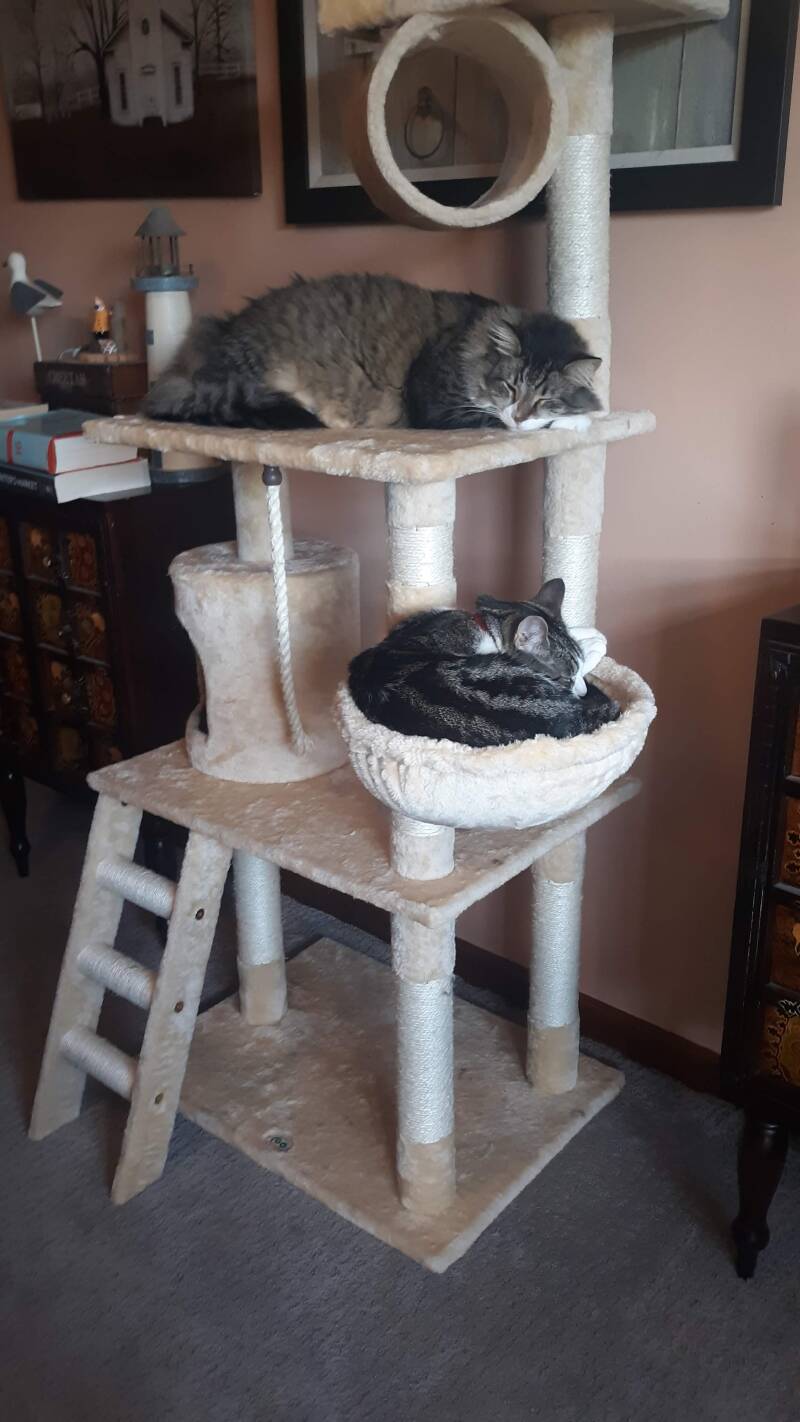
When your cat’s climbing a cat tree, it’s a big cat in the wild. It might be asserting its authority as the ruler of a jungle, looking for prey to pounce on, or escaping an imaginary predator. Regardless of the game it’s playing, your mini-tiger is having a blast.
And a cat tree does more than entertain your feline. It improves its physical and mental health. The vertical space created by a cat tree reduces anxiety in multi-cat households and gives cats a place to scratch other than your sofa.
If you have a cat, you should buy it a cat tree.
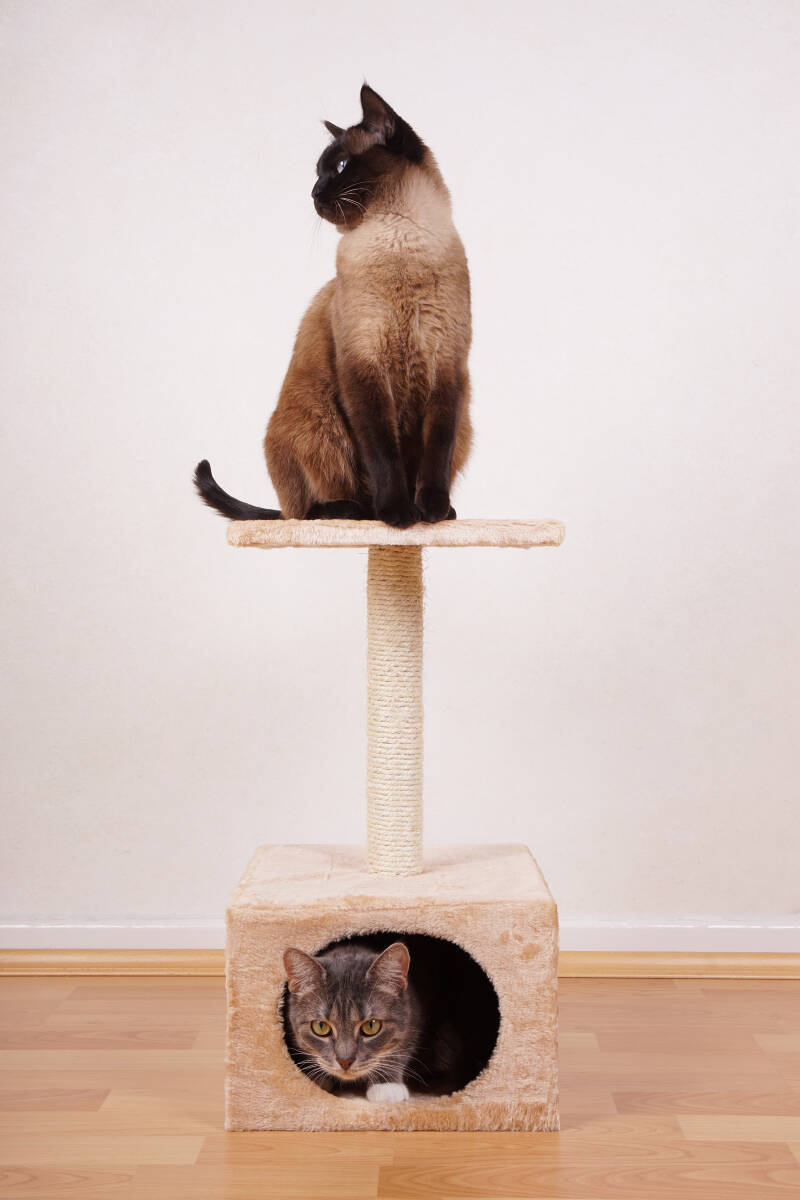
A small cat tree

"I think I can jump on top of the bookcase from here."
Types of Cat Trees
Cat trees—like cats—come in many shapes, sizes, and colors. They also go by many different names. A cat tree might be called a cat tower, kitty condo, cat mansion, cat activity center, or cat apartment.
Cat trees run the gamut from a 3-foot-tall tree with a single cat perch to a 10-foot-tall tree with shelves, ramps, tunnels, hammocks, toys, and hideouts. An elaborate cat tree might even have a built-in exercise wheel.
These structures also vary in cost. A small cat tree costs about $50 while a large wooden tree with lots of bells and whistles might set you back $300. A cat tree that’s built onto a wall and looks like a real tree—a work of art—costs (brace yourself) about two grand (https://www.spryinterior.com/products/handmade-wooden-cat-tree-modern-large-climbing-tree-unique-sinltt013). Does your cat need a super expensive cat tree? Think about it this way: Do you need a Porsche to get to work, or can you get there in a Hyundai? Basic is fine.
Vertical Space
A cat tree gives a cat vertical space. This means it can use the space above the floor and furniture. If your living space is small, adding vertical space makes your home seem larger to your cat.
Vertical space gives a cat a sense of security. It can see what’s going on better when it’s in a cat tree. It can escape from predators (which might be other cats, dogs, kids, or visitors). It can also spot prey (which might be a favorite toy).
If you live in a multi-cat household, adding vertical space may help your cats get along better. Vertical space makes it easier for one cat to get away from another cat that it considers a threat.
Adding vertical space makes it more likely that cats will play together, which is great exercise. They can also use the cat tree to access an even higher space, like the top of a bookcase.
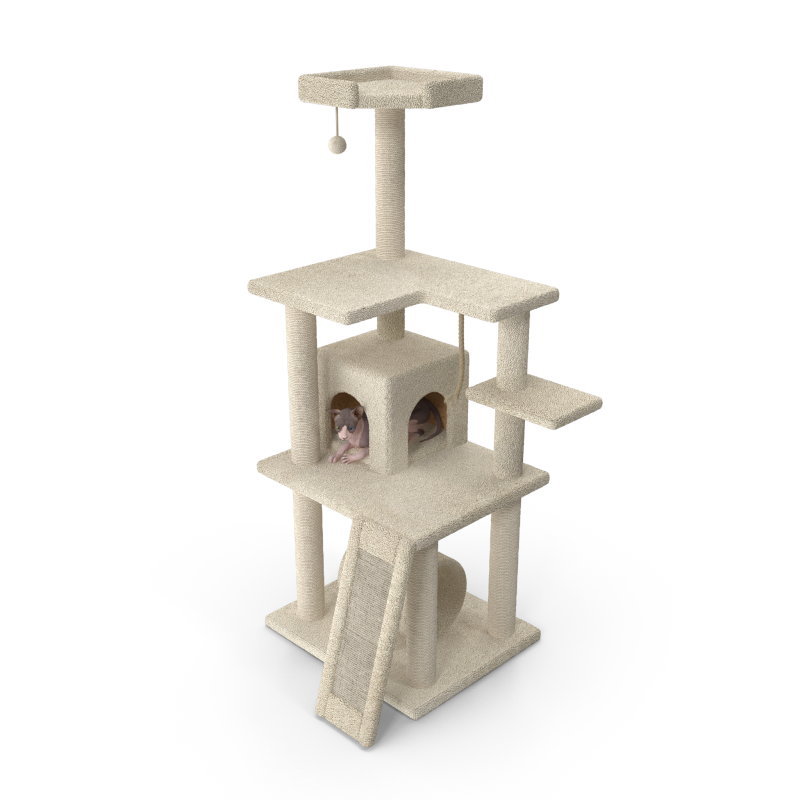
A large cat tree with four levels and a cubbyhole
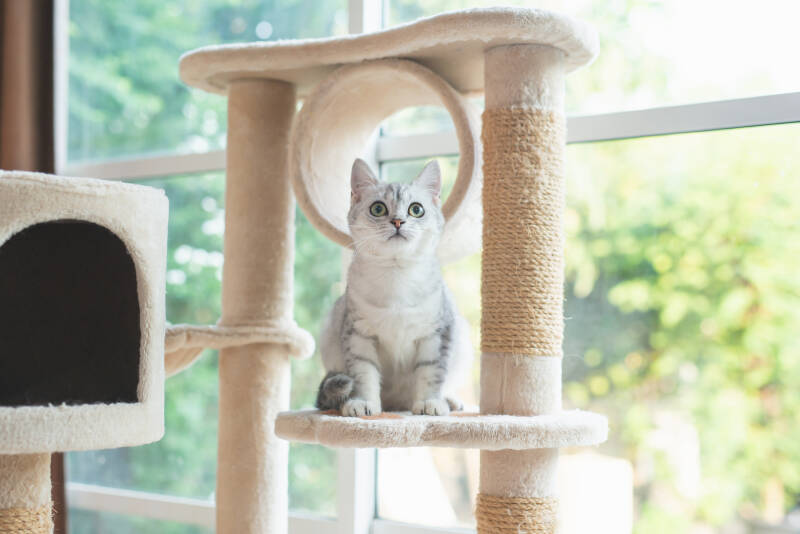
A cat tree with a sisal rope scratching post up high
Cat Tree Parts
A cat tree has at least one trunk. This is the "tree" part of the structure.
The posts may be made of plywood, solid wood, particleboard, cardboard, or plastic—or a combination of these materials. The posts are covered in carpet or another material.
A cat tree will have shelves and/or perches. They’re usually made of wood or plastic and covered in carpet or faux fur.
Scratching Posts
Most cat trees have at least one built-in scratching post for cats to rip into. Cats scratch to remove the dead part of their nails and stretch their muscles. They also scratch to mark their territory using the scent glands in their paws.
Cats like to scratch when they wake up from a nap. Since they like to sleep in cat trees, having a built-in scratching post nearby makes sense.
Most cats enjoy scratching on a carpeted post. But some prefer to dig their claws into sisal, a stiff fiber that’s used to make rope.
Take note whether your cat prefers a vertical or a horizontal scratcher. (Seriously, this is important.) Vertical scratchers like to reach up and pull down. Horizontal scratchers prefer a flat surface.
Horizontal scratchers might enjoy a horizontal scratching post in addition to a cat tree. You can buy the inexpensive cardboard kind. But they make a mess and have to be replaced often. Another option is to treat your cat to a post that looks like a balance beam. Some are covered in sisal rope.
A Cozy Den
Some cat trees have a den, which is a cubbyhole. These small spaces make great hiding places as well as cozy spots for napping.
Bells and Whistles
A cat tree might have hanging toys, ramps, and tunnels. It might have baskets and hammocks. Our cats love to curl up in baskets and will beat the crap out of each other over a hammock.
What Kind of Cat Tree Is Best?
The ideal cat tree depends on your space and budget. If you live in a small apartment and have only one feline companion, you can make do with a small cat tree, like the one shown here.
If you live in a multi-cat household and have a medium to large living space, a larger cat tree with several shelves and perches makes sense. Larger cat trees often have scratching posts near the top, which cats love.
You don’t have to break the bank to buy a large cat tree, either. An inexpensive one costs about $100 to $150. Why so cheap? Because they have cardboard tubing under the carpet or sisal on the posts instead of solid wood.
In time, your cats will claw their way into the cardboard, and at least part of the tree will collapse. The cats won’t get hurt, and this is no big deal—but you’ll need to replace the cat tree. Unless you keep actual tigers in your home, an inexpensive cat tree should last about two years.
The more expensive trees have posts made of solid wood, which last longer. (They’re better for large cats who think they’re actually tigers.)
Ladders
You can buy your cat a full-size ladder instead of or in addition to a cat tree. Cat ladders may have a hammock, but they don’t have a scratching post. Most cats love climbing and sleeping on cat ladders.
A Word of Caution
Don’t give your cats a used cat tree. While the price is right (cheap or free), it has the scent of other cats on it. Remember that cats have scent glands in their paws and mark their territory when they scratch. Your cat might not use the tree. It might even become more aggressive because of it.
And, even if a used cat tree looks clean, it might have pests on it like fleas and mites. Ick. And if the cat that used it had a contagious disease, your cat can catch it. Buying your cat a cheap cat tree is a much better option.
Be aware that even if you bought it new, you need to clean a cat tree every now and then. How does one do this? A vacuum cleaner with a hose works well. A shop vac is also a great option.