

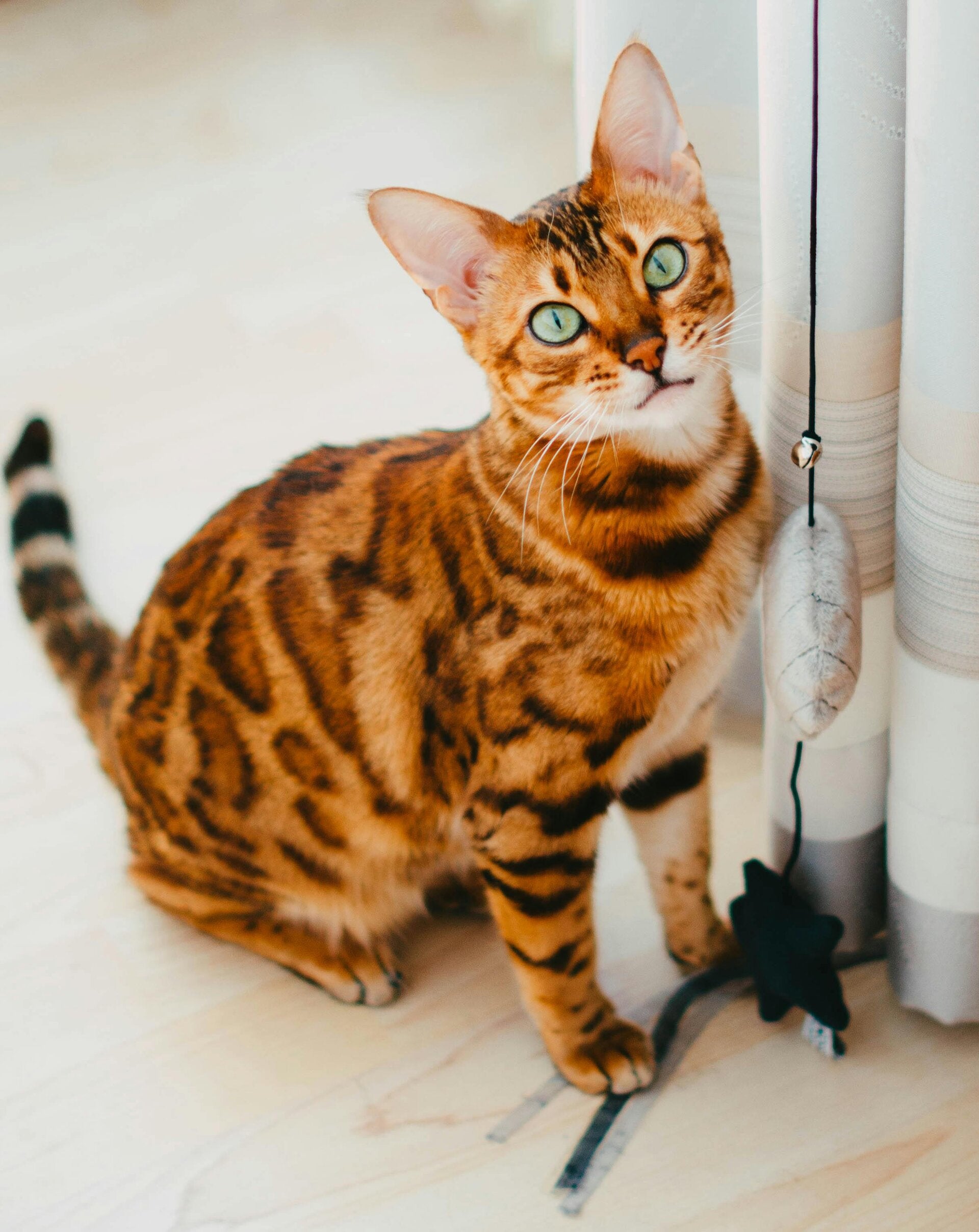
A Bengal cat looks like a mini-leopard. This high-energy cat breed is a cross between a domestic shorthair and an Asian leopard, is a small spotted wildcat.
Because they’re related to wild cats, Bengals are banned in some US states, like Hawaii and Connecticut. Other states, like Delaware, require you to obtain a permit before bringing a Bengal kitten or cat into your home. Some cities, such as New York City, ban Bengal cats.
Bans and restrictions on Bengals stem mainly from safety concerns. While most Bengals are affectionate and friendly, some can be aggressive. Bengals also have a strong prey drive. If one escapes from its home, it can significantly harm a native ecosystem.
Bengals are not recommended for families with young children or inexperienced cat owners.
Appearance
A Bengal cat is exotic-looking. Its coat is short and thick with rosettes. These are darkly outlined spots with a lighter center. Some Bengals are marbled instead of spotted. This means they have large swirls instead of spots. Coat colors include beige, brown, silver, charcoal, and black.
Bengals are on the smaller side. They’re muscular and weigh between 6 and 15 pounds.
They have large, round eyes that are set far apart. They have small ears with rounded tips. Bengals have wide, flat noses and round, thick tails.
They don’t shed much and have an average lifespan of 12 to 17 years.
Breeding and Origin
Bengals are classified by the letter F followed by a number. This refers to how many generations the cat is from the initial breeding of a domestic shorthair and an Asian leopard cat. An F1 classification means a Bengal is the first cross between these two cats. These cats are considered early-generation Bengals and are also called foundation Bengals. F1 males are usually sterile, so F1 females are bred to males of later-generation Bengals. As the generations progress to F2, F3, and beyond, the cats become more like domestic cats that are spotted like leopards.
These classifications are important because the lower the number, the wilder the cat. Early generations are often banned in US states. For example, Alaska allows Bengal cats as long as they are generation F4 and beyond.
Behavior
Bengals are intelligent and energetic. They’re vocal cats that may follow their humans around the house while “talking” to them. Most are friendly and sociable.
These cats are extremely athletic and active. They don’t like being held and have strong hunting instincts. They need to run, climb, and jump every day. If you adopt a Bengal, expect to spend an hour per day playing with it. If you don’t do this, your kitty will get bored and become destructive.
In terms of play, Bengals enjoy fetching toys and jumping high in the air while chasing them. Some enjoy daily walks on a harness and leash. Cat toys with puzzles and cat wheels are great for Bengals—anything that prevents boredom. Some Bengals like water and are fascinated by dripping faucets and like to play in water in bathtubs. Bengals enjoy the vertical space created by tall, sturdy cat trees.
Bengals vs Savannahs
Bengals are similar to Savannahs in appearance and behavior. A Savannah is a cross between a domestic cat and a serval, a wild African cat. Savannahs are larger and taller than Bengals and have larger ears.
Adopting a Bengal
You can adopt a Bengal kitten or cat from a breeder, but be careful! Considering the breed’s temperament, it is especially important to adopt from a reputable breeder. High-quality breeders love their cats and will encourage you to visit their facility. They will also carefully screen you to make sure you can provide a kitten with a good home before giving it to you. A Bengal kitten costs between $1,500 and $3,000.
You can also adopt a kitten or cat from a Bengal rescue group. Make sure Bengals are allowed in your state and be aware of any restrictions before you acquire one.