

Cat lovers may use the terms stray and feral interchangeably, but they have different meanings. A stray cat has been socialized by people, but a feral cat has not.
Stray Cats
A stray cat is misplaced. Although it has spent its life with humans, it has lost its home and may be lost. This can happen when an indoor-only cat slips out a door or window.
A stray cat may have also been abandoned. When shelters and rescues are full, cruel people dump off cats, making them strays.
Indoor/Outdoor Cats
A stray cat is not an indoor/outdoor cat that has a home. While it is not a good idea to let a cat roam freely outdoors, some people do. If a cat is hanging around your house, ask neighbors if it belongs to them, so you don’t inadvertently take someone’s cat to a rescue or shelter.
Behavior
An outgoing stray cat may approach humans, making eye contact and responding to calls or offers of food. It might meow and walk with its tail up. It may purr, rub against legs, and allow petting.
However, most cats are not this brave. A stray cat that is lost or has been abandoned may act like it’s afraid of people because, at that moment, it is.
Stray cats that are outside for a long time without human contact may become feral. However, if taken inside and loved again, most strays will once again learn to trust humans, realizing that they are not all scumbags who toss pet cats outside to fend for themselves.

Feral Cats
Feral cats are wild and unsocialized. Kittens have a socialization window. This is when they can become tame. For most kittens, the socialization window is between the ages of two and seven weeks old.
If too much time passes without having contact with people, they’ll become feral cats. This is true even if their parents are
are tame.
Feral kittens will hiss and growl at first but will learn to appreciate human kindness and become house cats. In some cases, kittens older than seven weeks can be tamed.
Behavior
Feral cats shy away from people. They may hide during the day and come out at night. They don’t walk with their tail in the air or meow at passersby.
If a feral cat is cornered, it may hiss and growl. Feral cats without access to food and shelter are dirty, thin, and often sick.
Taming
Can a truly feral cat be tamed? Sometimes. Feral cats aren’t mean—they’re terrified. If cornered, they think they are fighting for their lives. When they are spayed or neutered and treated with kindness—given food and shelter—they become less scared.
Many people say full-grown feral cats can never be tamed, but this isn’t always true. While some never “come around,” others learn to trust people, especially those who are caring for them.
Whether a feral cat will eventually become tame depends on the cat. If a feral cat has been spayed or neutered, it is more likely to become socialized. According to animal behaviorists, a feral cat may tame more easily if one or both of its parents were tame.
Yet, many tame feral cats are not like house cats. They may be skittish. While they love their owners, they hide from visitors.
Shelters often advise people against trying to tame feral cats. This is because shelters are inundated with loving cats in desperate need of homes. In many cases, it’s better to adopt a cat from a rescue or shelter than to try to tame one that has been living outdoors—but this is easier said than done. People who try to help feral cats by fixing and feeding them get attached to them, and vice versa. They’re often compelled to give these cats a safe, indoor life.
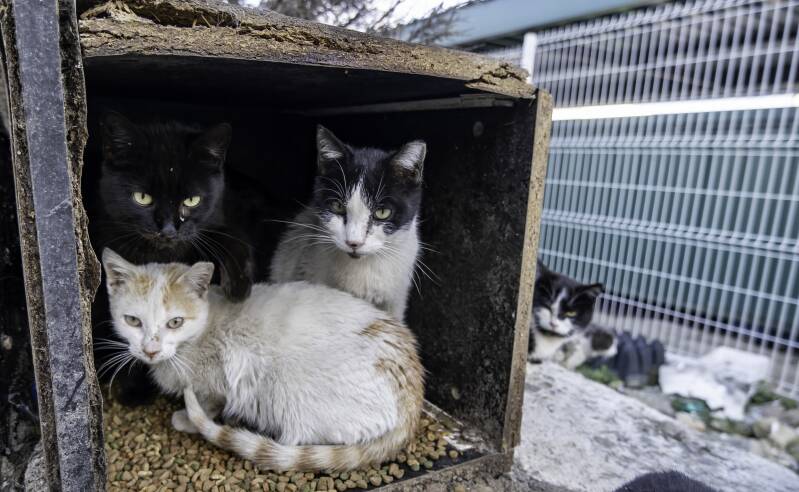
Feral cats are often thin and dirty.
How to Help a Stray Cat
Stray cats are no longer in their home. They require assistance due to their unfamiliar surroundings. They won’t last long outdoors. If you can’t find a stray cat a good home, take it to a rescue or a shelter.
Our cat Ollie is a cow cat, a white cat with black spots. He was abandoned near our home. When I first saw him, he was panicked and running up and down our street. It was January and cold outside.
I wanted to help him, so I fed him while sitting on the ground nearby and talking to him softly. Ollie made eye contact with me—his eyes looked so freaking sad—but he bolted whenever I tried to get close. I did this for weeks, but he kept running away. He wasn’t a feral cat, but he was much too scared to come to me.
I made him an outdoor shelter to help him survive the winter. I put it under some bushes, where it was concealed. I was relieved to see him sleeping inside it.
But when the temperature dropped below zero, I knew Ollie was in grave danger. Feral cats that have lived their entire lives outdoors struggle to survive in such weather. Poor Ollie didn’t have a chance.
I set a humane cat trap next to his shelter and put warm food inside it. He went for it—the trapdoor snapped shut—and I caught him. I kept him in a spare bedroom away from our other cats until he had been examined by a vet, vaccinated, and tested for diseases like feline leukemia virus (FeLV).
In case he was lost, we took his picture and put it on social media under the heading “Found Cat.” We made posters and hung them in our neighborhood.
Nobody claimed Ollie, so we kept him. He is one of the most loving, gentle cats we’ve ever had.

Our lovable cat Ollie, living the good life indoors
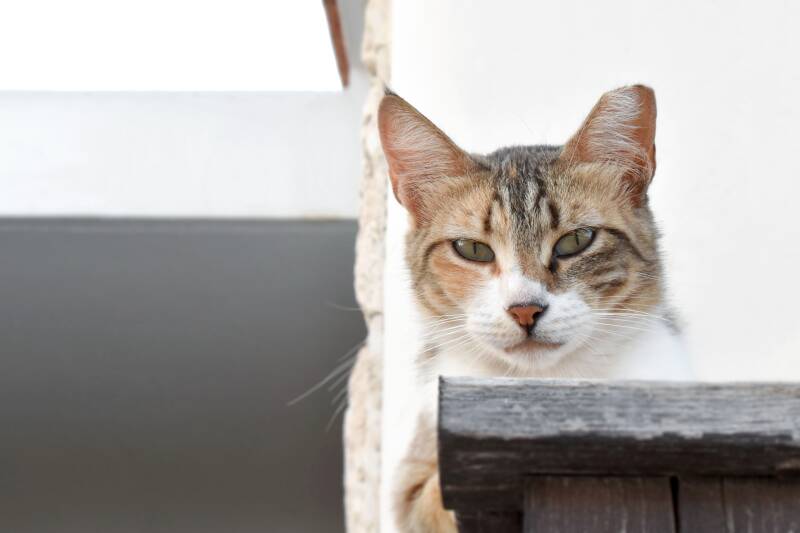
Cat with an eartip
How to Help a Feral Cat
Human intervention can improve feral cats’ lives. Rescue group volunteers TNR feral cats—meaning they trap, neuter, and return them to their original location. Fixing them reduces the feral cat population in an area over time. Feral cats that are taken to shelters are nearly always euthanized.
Releasing these cats in the location where they were trapped is important. If they are set free in a new place, they may try to return to their original location even if it’s miles away. This is super dangerous.
Fixing feral cats improves their lives in many ways:
- After they’re spayed or neutered, feral cats don’t yowl, fight, or spray. They usually don’t roam, so they’re less likely to bother neighbors.
- Their coats become thicker and cleaner. They can gain more weight. They also receive vaccinations when they’re spayed or neutered, which protects them from diseases and helps them live longer.
- Feral cats that live in groups are called community cats. If they’re lucky, they have caretakers who provide them with food and shelter. They’re more likely to stay in one place if they are given these essentials.
Eartipping
Feral cats that have undergone TNR get an eartip. This means the tip of their left ear has been cut off. Don’t scream. It’s done while they’re under anesthesia and getting spayed or neutered. It doesn’t hurt or bleed much.
An eartip lets people know that a cat is part of a TNR program and has been fixed. It sends a message that somebody is taking care of the cat (so you better not mess with it or you might get an eartip!).
Role in Pest Control
Community cats help manage rodent and other small pest populations in urban areas. Feral cats hunt mice and rats, reducing their numbers naturally. This can be beneficial for neighborhoods where rodent infestations pose health risks or cause property damage.
Effects on Local Ecosystems
Community cats can negatively impact local wildlife, especially birds. They might reduce the populations of some species, which makes bird-lovers go batty, threatening to take out the cats and their caretakers.
They need to realize that if community cats are spayed or neutered, they can’t reproduce, and their population decreases over time. Cats are territorial, so new ferals get chased out of a cat community.
This is why catching and killing feral cats doesn’t reduce the population. Once the original cats are gone, new cats move in to take their place.
It’s better to have a community of ten fixed cats than ten reproducing ones. Now, you’re probably asking yourself what happens when the original fixed cats die off. Hopefully, this won’t happen for a long time. Because these cats are getting care, they might live ten years or longer. When they do pass away, and new cats move into the area, they also need to be TNR-ed.
The Boardwalk Cat Project
Have you ever been to Atlantic City, New Jersey? If you have, you might’ve seen cats basking in the sun on the docks. The “Boardwalk cats,” as they’re called, are part of a massive TNR project that began in 2000. Each cat in the program has been trapped, spayed or neutered, and vaccinated. It has also been given an eartip. The Boardwalk cats are cherished by both visitors and residents.